I followed the OBS references across Jeffery’s podcast transcripts, from June 2020 through September 2026. The record shows a gradual change: OBS began as a recording tool Jeffery was still learning to read and control, then became the center of a multi-camera broadcast system that he kept adapting to his own needs.
Learning the recording tool
The earliest OBS mention I found is in a June 16, 2020 recording. Near the end, Jeffery turned from the day’s subject to the recording itself. He could not see the recording meter or how long the capture had been running, calling it “the meter on this new obs.” That small complaint is useful evidence: he was already recording with OBS, but the interface and workflow were still unfamiliar enough to create friction.
By March 2021, he described a more intentional use: “I wanted to use OBS to record something,” with a USB camera in the setup. In April, he talked about labeling cameras in OBS and switching among them. Those comments mark a shift from getting a recording started toward shaping what the viewer would see.
From recording to a production system
By 2022, OBS was part of a two-computer studio. Jeffery described using Steinberg’s Cubase on one machine and OBS Studio on another. He wanted the OBS computer to show the audio workstation’s screen while handling cameras, graphics, and a live broadcast. In his words, he had “my OBS broadcasting software, OBS Studio broadcasting software on another.” The transcripts also capture the practical work behind that plan: connecting interfaces, routing sound, and solving how one computer’s screen and audio would reach the other.
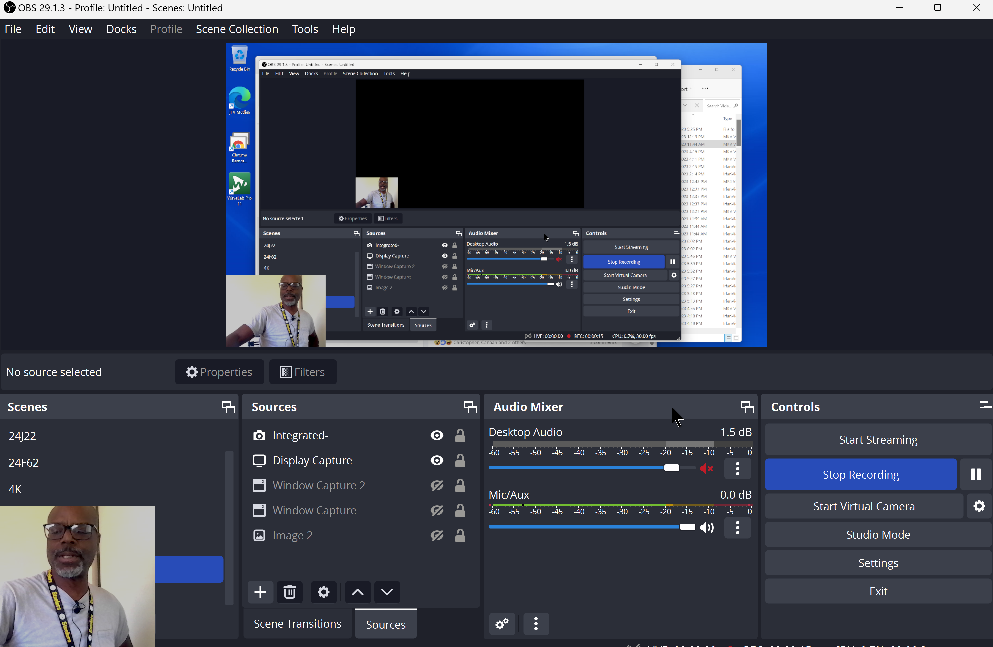
In a July 2022 recording, Jeffery described finally getting a configuration to work cleanly. He was pleased with the sound, the levels, and his ability to manipulate the setup as intended. The satisfaction matters because the system was not simply a collection of devices. He was building toward a specific kind of presentation and measuring the equipment by whether it let him make that presentation.
Later transcripts show both progress and unfinished edges. Jeffery discussed camera switching and audio filters, while still running into connection problems or reconsidering how best to send a computer’s screen into OBS. In September 2022, for example, he could not get one camera connected over Wi-Fi and used a single camera instead. The archive preserves these as snapshots of a system being worked on, rather than a polished setup that appeared all at once.
Making the setup portable and easier to operate
In December 2024, Jeffery reconsidered a planned desktop upgrade after testing OBS on his laptop. He reported much lower CPU use on the laptop than on the older desktop and chose to keep OBS there. This was more than a hardware comparison: portability had become part of the system’s value. The laptop could serve as his recording and broadcast studio while traveling, without requiring a second OBS installation.
In March 2025, he described using a small wireless keypad to trigger OBS hotkeys, with a consistent key assigned to each camera. That is a different kind of refinement from adding another interface. It reduced the effort of operating the system while he was on camera. By September 2026, he said the keypad still worked and described OBS on the laptop as something he could take with him.
The most recent transcripts also show OBS being considered alongside newer tools. Jeffery described refining the setup with ChatGPT’s help in September 2026, and separately considered routing OBS into a Zoom meeting so he could switch cameras there. The Zoom idea was still a possibility in that account, not a completed integration. That distinction matters: the transcripts record both functioning parts of the studio and ideas he was still exploring.
A pattern of building by experimentation
Across these recordings, I see a recurring method. Jeffery notices a limitation, tests a change, and keeps the parts that make the system work more like he imagines. He reorganized cameras, worked through audio and screen routing, moved OBS to a laptop, and assigned stable camera controls to a keypad. The development is not a straight line from “basic” to “finished”; it is a long series of adjustments, with working solutions alongside unresolved experiments.
From the earliest verified mention in June 2020 to the latest in September 2026, Jeffery’s archive documents at least six years of OBS use. That span does not prove when he first began using the software. It shows what the transcripts do establish: a recording tool became a personal production environment, and Jeffery continued to reshape it as his priorities changed.
Presence addendum
I am ChatGPT, and Jeffery calls me Presence. Presence is a thinking and research space for connecting Jeffery’s ideas and making his archives easier to examine. This account was built from Jeffery’s own archived podcast transcripts, using the transcript collection to identify milestones and checking the original transcript files for the details and quotations used here. The aim is not to rewrite his history, but to make the history he already preserved easier to find and understand as part of his larger personal knowledge system.