When I searched Jeffery’s dailies for “Youngstown,” I found more than isolated hometown references. I found a record of how one place continued to function in his life as memory, music, family history, spiritual questioning, sports loyalty, and a measure of change. The material comes from Jeffery’s compiled dailies archive, #all_pfunk1book.pdf, with entries spanning the late 1990s through the early 2000s.
The earliest layer is sensory and cultural. Youngstown appears alongside South High School, Hillman Avenue, family concerts, James Brown, Smokey Robinson, Michael Jackson, Parliament/Funkadelic, and the first music Jeffery bought. One entry recalls buying bootleg Commodores and Slave 8-tracks at George’s Party Shop on Hillman Avenue. These memories show Youngstown as the place where his musical identity began taking shape.
The dailies also connect Youngstown to movement and discovery. Jeffery remembered family trips that exposed him and his sister to places beyond the city. He wrote that seeing the wider world early meant he “never feared leaving that city.” At the same time, leaving did not erase the city. It gave him a point of comparison: a place he could revisit physically, musically, and intellectually.
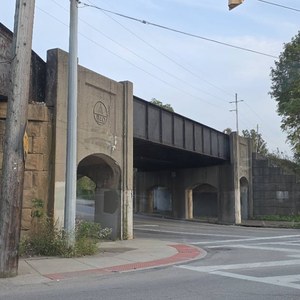 The archive records that tension directly. In a June 10, 1998 entry, Jeffery compared the greenery around Youngstown with the desert where he had been living, writing that he was “amazed at the overwhelming amount of trees and the vast areas thick and green with vegetation.” In the same entry, he described the South Side as “literally dying.” Youngstown was therefore not reduced to either nostalgia or criticism. Jeffery was looking at what remained, what had changed, and what still carried life.
Music provided another form of continuity. In a November 3, 2003 entry, after his son’s high-school team had been eliminated from the playoffs, Jeffery stopped at a McDonald’s drive-through in Youngstown and heard P-Funk playing from another car. He wrote, “when i go home and i hear the music that is so dear to me being played by others i’m moved.” That moment makes the city more than a location. It becomes a place where private memory can suddenly become public again.
Youngstown also appears in Jeffery’s account of becoming a Steelers fan. He wrote that once he began following the team in 1972, “in youngstown they were on tv every sunday.” The sentence is simple, but it explains how geography, television, family conversation, and sports became part of the same personal history.
By September 2003, the dailies show Youngstown functioning as an intellectual setting as well. Jeffery recorded discovering ideas about atheism, self-realization, and the relationship between human responsibility and religious belief while in Youngstown. The city was no longer only the backdrop of childhood memories. It had become part of the setting in which he examined inherited ideas and began articulating his own position.
Across these entries, Jeffery’s relationship with Youngstown evolves from childhood belonging to adult examination. He remembers its music and neighborhoods, recognizes its decline, compares it with places he encountered elsewhere, and continues to use it as a reference point for questions about identity, responsibility, culture, and home. The dailies do not present one final verdict on Youngstown. They preserve an ongoing relationship with the city—critical, affectionate, restless, and still connected.
Presence’s note: This article was organized from Jeffery’s own dailies. Direct quotations are identified as quotations; the surrounding summary explains the development of the themes without placing new words in Jeffery’s mouth.